



















Best Probiotic Strains: Which One Is Right for Your Health Goal?

The word "probiotic" on a supplement label tells you almost nothing about what it will actually do. What matters is the strain — the specific, named designation at the end of the full scientific name. Lactobacillus rhamnosus GG, for example, has decades of clinical evidence for preventing antibiotic-associated diarrhea. A different Lactobacillus rhamnosus strain from a different company may not. Same genus, same species, completely different evidence profile.
This guide maps the best probiotic strains by health goal — digestive health, immune support, mood, skin, and cognitive function — with evidence ratings per category and a practical decision framework so you can match the right strain to your specific need. To understand how probiotics work at a foundational level before diving into strain selection, that article covers the basics.
Key Facts Before You Buy
- Probiotic benefits are strain-specific. L. rhamnosus GG for antibiotic diarrhea is not interchangeable with B. longum for mood support.
- CFU count matters less than strain match. 10 billion CFUs of the right strain outperforms 100 billion of the wrong one.
- Most strains are transient. They do not permanently colonize the gut — daily use is required to maintain benefits.
How to Read a Probiotic Label: The Strain Naming System

Probiotic names follow a three-part structure: genus + species + strain designation. Every part of that name narrows the identity, and the strain designation is where the clinical specificity lives.
Take Lactobacillus rhamnosus GG as an example:
- Lactobacillus — the genus (a broad family of lactic acid bacteria)
- rhamnosus — the species (still a very large group of bacteria)
- GG — the strain designation (the specific isolate tested in clinical trials)
A supplement that lists only "Lactobacillus rhamnosus" without the GG designation may contain a completely different strain. The World Gastroenterology Organisation 2023 Guidelines are explicit on this point: probiotic recommendations should be made at the strain level, not the species level.
Two main genera dominate the clinical evidence for human supplementation:
- Lactobacillus strains: primary activity in the small intestine; most-studied for digestive health, immune function, and mood
- Bifidobacterium strains: primary activity in the large intestine and colon; particularly important for IBS, immune signaling, and the gut-brain axis
A third category worth knowing: Saccharomyces boulardii. Unlike Lactobacillus and Bifidobacterium, S. boulardii is a yeast — not a bacterium. This makes it uniquely resistant to antibiotics, which is exactly why it is the strain of choice during antibiotic courses.
When reading a supplement label, look for:
- The full three-part strain name (not just genus or genus + species)
- CFU count listed at end of shelf life, not at manufacture — a meaningful distinction for live cultures
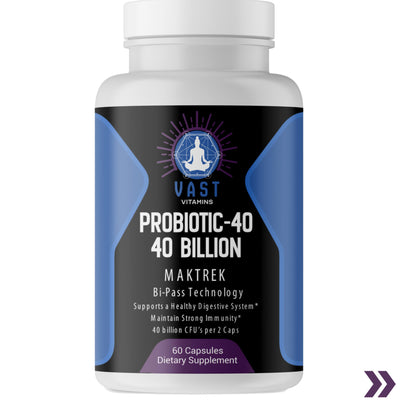
- Delivery technology: acid-resistant coating, enteric coating, or MAKtrek bi-pass technology protects live cultures through stomach acid before they reach the intestine
What Are CFUs and How Many Do You Actually Need?
CFU stands for colony-forming units — a measure of the number of viable, live microorganisms in a dose. The research-supported range for most adult health goals is 10–50 billion CFU per day, per the NIH Office of Dietary Supplements.
Higher CFU counts do not mean better results. Strain match is the variable that drives outcomes. A 10 billion CFU dose of L. rhamnosus GG for antibiotic diarrhea has more clinical support than a 100 billion CFU product that doesn't list strains at all.
A few practical timing notes:
- Take probiotics with a fat-containing meal — fat improves survival through the gastric environment
- If you are taking antibiotics, take your probiotic 2–3 hours after the antibiotic dose, not simultaneously — the antibiotic will kill the probiotic if taken together
- Saccharomyces boulardii is the exception: as a yeast, it survives antibiotic exposure and can be taken alongside antibiotic doses
Best Probiotic Strains by Health Goal
The sections below organize the best probiotic strains by health outcome rather than by strain name, which is how most people actually search for a probiotic. Evidence ratings reflect the quality and consistency of the clinical literature for each goal category.
Evidence rating key: ★★★ = multiple high-quality RCTs with consistent results | ★★☆ = solid evidence with some caveats | ★☆☆ = emerging evidence, shows promise but needs more research
Best Probiotic Strains for Digestive Health and IBS ★★★
Digestive health has by far the strongest clinical evidence of any probiotic application. A 2024 umbrella meta-analysis (PMC12183855) covering multiple GI conditions found probiotics reduced risk of diarrhea (RR 0.44), bloating (RR 0.74), and epigastric pain (RR 0.71) compared to placebo.
The top strains for this category:
- Lactobacillus rhamnosus GG: the most-studied probiotic strain in the world; strongest evidence for antibiotic-associated diarrhea and C. difficile risk reduction; also well-studied for IBS and its acid-resistance profile is exceptional
- Saccharomyces boulardii: yeast-based, survives antibiotic exposure; strongest evidence for traveler's diarrhea and C. diff prevention; increasingly studied for IBD
- Bifidobacterium infantis 35624: IBS-specific evidence; a 2006 RCT showed significant reductions in pain, bloating, and bowel movement difficulty versus placebo
- Lactiplantibacillus plantarum 299v: well-studied for IBS-specific abdominal pain and bloating, particularly in gastroenterology literature
For IBS specifically, multi-strain formulas have an evidence edge. A 2023 network meta-analysis (PMC10490209) confirmed that multi-strain combinations outperform single strains on the IBS Symptom Severity Score.
Best Probiotic Strains for Immune Support ★★★
The gut houses 70–80% of the body's immune system within gut-associated lymphoid tissue (GALT). Probiotic colonization of the gut directly activates immune signaling pathways — making this a mechanistically grounded application, not just an observational one. For a deeper look at the mechanisms involved, see our article on how probiotics support immune function.
A 2021 review (PMC8512487) found that probiotics regulate microbiota composition to improve immunity, primarily through Toll-like receptor (TLR) modulation in GALT.
The top strains for immune support:
- Lactobacillus rhamnosus (multiple strains): consistently reduces duration and frequency of upper respiratory infections in both adults and children
- Bifidobacterium lactis BB-12: one of the most-studied strains for immune resilience; promotes production of secretory IgA — the antibody that lines the gut and respiratory tracts
- Lactobacillus acidophilus NCFM: more than 60 clinical studies; supports gut barrier integrity and immune balance through GALT activation
Important timing expectation: immune benefits from probiotic supplementation typically require 4–8 weeks of consistent daily use before measurable changes appear. Week-one results are not a reliable indicator.
Best Probiotic Strains for Mood and Anxiety (Psychobiotics) ★★☆

"Psychobiotics" is the emerging clinical term for probiotic strains with demonstrated activity on the gut-brain axis. Approximately 90% of the body's serotonin is produced in the gut, and specific probiotic strains appear to enhance serotonergic signaling — a mechanism reviewed in a 2024 study (PMC10867509).
This is a ★★☆ category — the evidence is solid but comes with caveats: studies typically run 8–12 weeks with small sample sizes and non-standardized outcome measures. The mechanism is well-established; the clinical effect sizes are still being quantified.
The most-studied psychobiotic combination is Lactobacillus helveticus R0052 + Bifidobacterium longum R0175. A 2011 RCT using this pairing showed significant reductions in self-reported anxiety and depression scores versus placebo. A 2023 study (PMC10410452) confirmed the gut-brain axis pathway via the vagus nerve and serotonin production.
- Lactobacillus helveticus R0052 + Bifidobacterium longum R0175: the most-researched psychobiotic pairing; acts via serotonin signaling and vagus nerve pathway
- Bifidobacterium longum NCC3001: shown to reduce anxiety scores specifically in IBS patients, with functional brain imaging evidence
For a broader look at the serotonin pathway and other approaches to supporting mood through gut health, our article on increasing serotonin naturally covers complementary strategies. The gut-brain connection is also central to understanding how these mechanisms work.
If you are addressing mood alongside stress or anxiety, consistency over 8+ weeks is required — this is not a fast-acting category.
Best Probiotic Strains for Skin Health ★★☆
The gut-skin axis operates through intestinal permeability. When the gut barrier is compromised ("leaky gut"), inflammatory molecules can enter the bloodstream and reach the skin. Probiotic strains that strengthen the intestinal barrier have downstream effects on skin inflammatory conditions — including acne, eczema, and psoriasis.
A comprehensive 2024 review in Frontiers in Microbiology (fmicb.2024.1487641) catalogued the gut-skin evidence, noting that probiotics improved psoriasis severity scores in 5 of 6 RCTs reviewed.
Key strains with skin evidence:
- Lactobacillus rhamnosus SP1: adult acne evidence; linked to reductions in IGF-1 signaling, a known acne-promoting pathway
- Bifidobacterium longum: studied for atopic dermatitis; maternal probiotic use during pregnancy and breastfeeding shows modest eczema reduction in infants
- Lactobacillus acidophilus: studied alongside Bifidobacterium for psoriasis and eczema severity
Skin benefits require 8–12 weeks of consistent use. Topical probiotic skincare is a separate category from oral probiotic supplementation and is not covered here.
Best Probiotic Strains for Cognitive Function ★☆☆
Cognitive function is the most emerging area of probiotic research — and early results are genuinely encouraging, though the evidence is still developing.
A 2024 meta-analysis (PMC12645680) pooled 34 RCTs with 2,390 participants and found small but real improvements in cognitive function at 12 weeks of probiotic supplementation, particularly in executive function and memory scores. The effect sizes are modest, and the authors describe the evidence as "limited but suggestive."
Strains most frequently studied:
- Lactobacillus helveticus: studied for both mood and cognitive outcomes (often in combination with B. longum)
- Bifidobacterium longum: the most consistent performer across mood and cognitive study designs
- Multi-strain formulas: most 34-RCT meta-analysis results used multi-strain protocols; single-strain cognitive data is more limited
The current picture: cognitive benefits are most consistently seen in people whose cognitive symptoms are linked to gut dysfunction (brain fog alongside IBS or IBD). General cognitive enhancement in healthy adults remains less clear. This is a category worth watching — the 2024 meta-analysis is the first comprehensive synthesis, and the research base is growing quickly.
Strain-Selection Quick-Reference Table

Use this table to match your primary health goal to the strains most supported by clinical evidence.
| Health Goal | Top Strain(s) | Daily CFU | Duration Before Effect | Key Note |
|---|---|---|---|---|
| Antibiotic diarrhea / C. diff | L. rhamnosus GG, S. boulardii | 10–50 billion | During antibiotics + 1–2 weeks after | Take 2–3 hours after antibiotic dose; S. boulardii can be taken alongside antibiotic |
| IBS (all subtypes) | B. infantis 35624, L. plantarum 299v, multi-strain | 10–50 billion | 4–8 weeks | Multi-strain formulas outperform single strains for IBS Symptom Severity Score |
| General gut maintenance | L. acidophilus, B. longum | 10–20 billion | Ongoing | Foundational everyday strains; good baseline for most adults |
| Immune support | L. rhamnosus, B. lactis BB-12 | 10–20 billion | 4–8 weeks | Covers both respiratory tract and gut immune pathways |
| Mood / anxiety (psychobiotics) | L. helveticus R0052 + B. longum R0175 | 10–20 billion | 8+ weeks | Works via serotonin pathway + vagus nerve; requires sustained daily use |
| Skin health (eczema / acne) | L. rhamnosus SP1, B. longum | 10–20 billion | 8–12 weeks | Gut-skin axis mechanism; targets intestinal permeability, not skin directly |
| Cognitive support | L. helveticus, B. longum, multi-strain | 10–20 billion | 12+ weeks | Emerging evidence; strongest benefit in gut-symptom-linked brain fog |
How to Choose the Right Probiotic: A Practical Decision Framework
Most people feel "probiotics don't work for me" because they chose a generic product without knowing the strain. Choosing the best probiotic strains for your specific goal is the single highest-leverage change you can make. Here is how to pick correctly.
If your primary issue is digestive — bloating, IBS, post-antibiotic recovery:
Start with L. rhamnosus GG or a multi-strain formula that includes B. infantis 35624. Look for the named strain designation on the label, not just genus and species. For post-antibiotic use, add S. boulardii.
If you're immune-focused — frequent colds, low resilience after illness:
Look for L. acidophilus NCFM and B. lactis BB-12 together. These two strains cover both small-intestine and large-intestine immune pathways. Plan for 4–8 weeks before evaluating results.
If you're addressing mood or stress:
Look for the L. helveticus R0052 + B. longum R0175 psychobiotic pairing. Consistency over 8+ weeks is essential — this is a long-game intervention that acts through the serotonin pathway, not through immediate symptom relief.
If you want an all-purpose daily formula:
A multi-strain formula with 10–40 billion CFU covering 4–6 strains across both Lactobacillus and Bifidobacterium genera is the best starting point. This covers general gut maintenance, immune support, and provides a foundation for mood support over time. Our Probiotic 40 Billion CFU capsules use MAKtrek bi-pass technology — a marine polysaccharide delivery system that protects live cultures through stomach acid — so the strains actually reach the intestine where the clinical evidence is generated.
How long should I give it?
Minimum 4 weeks for digestive effects, 8+ weeks for immune and mood effects. If no improvement after 12 weeks, you likely need a different strain match — not necessarily a higher CFU count.
Can I take probiotics with antibiotics?
Yes. Take them 2–3 hours apart from your antibiotic dose. S. boulardii is the ideal antibiotic-companion strain because it is a yeast and survives antibiotic exposure.
Try Vast Vitamins Probiotic 40 Billion CFU
Our Probiotic 40 Billion CFU capsules use MAKtrek bi-pass technology — a marine polysaccharide delivery system that protects live bacterial cultures through stomach acid, so your chosen strains actually reach the intestine where they work.
What Probiotics Won't Do (And Why That's Fine)
Setting accurate expectations is what keeps people consistent with their supplement — and consistency is the primary driver of probiotic outcomes.
Most probiotic strains are transient. They do not permanently recolonize the gut. When you stop taking them, their benefit fades within weeks. This is not a failure of the supplement — it is simply how the mechanism works. Daily use maintains the presence and effect. Think of it like a daily multivitamin: you don't take it once and expect lifelong coverage.
Probiotics are not a cure for IBD, IBS, or mental health conditions. They are a gut-environment support tool that works alongside — not instead of — treatment. The evidence consistently shows probiotics improve symptom scores and quality of life measures, not disease remission in isolation.
The most common reason "probiotics don't work" is strain mismatch. A product that lists only "Lactobacillus acidophilus" without a strain designation has not been matched to a clinical outcome. Choosing a strain-matched product is the single highest-leverage change most people can make when upgrading their probiotic routine.
Prebiotic fiber feeds probiotic cultures. Probiotics work better in a fiber-rich gut environment — prebiotics (found in foods like chicory, garlic, onion, and leek, or in a prebiotic supplement) provide the substrate probiotic cultures need to thrive. If your diet is low in fiber, adding prebiotic sources alongside your probiotic improves efficacy.
Frequently Asked Questions

What is the most effective probiotic strain?
There is no single "most effective" probiotic strain — effectiveness depends entirely on your health goal. Lactobacillus rhamnosus GG has the largest body of overall research and is the most-studied strain in the world, per the World Gastroenterology Organisation 2023 Guidelines.
But it's best suited for digestive and antibiotic-related applications specifically — for mood, you need a different strain entirely. Use the quick-reference table above to match strain to goal.
How many CFUs do I actually need?
10–50 billion CFU per day is the research-backed range for most adult health goals, according to the NIH Office of Dietary Supplements. More CFUs does not mean more benefit — strain match is the variable that matters most. A 10 billion CFU dose of the right strain outperforms a 100 billion CFU dose of a strain with no evidence for your condition.
Can I take probiotics every day?
Yes — daily use is not only safe but necessary. Most probiotic strains are transient and do not permanently colonize the gut. Daily supplementation maintains the active population of strains in your intestinal environment. Stopping use means the benefit fades within weeks as the transient strains clear.
Do probiotics need to be refrigerated?
It depends on the product and the strains. Some strains (particularly Bifidobacterium species) are more heat-sensitive and benefit from refrigeration. Others have been stabilized through freeze-drying or microencapsulation and are stable at room temperature.
Look for "stable at room temperature" labeling for travel-friendly options, or follow the manufacturer's storage guidance. When in doubt, refrigeration extends shelf life for most live-culture products.
Can I take probiotics with antibiotics?
Yes — but take them 2–3 hours apart from your antibiotic dose, not simultaneously. Antibiotics are designed to kill bacteria, and taking your probiotic at the same time will reduce its viability.
Saccharomyces boulardii is the exception: as a yeast, it is not affected by antibacterial antibiotics and can be taken alongside antibiotic doses. For more on antibiotic microbiome effects, see PMC8756738.
Are there any probiotic side effects?
Temporary gas, bloating, and mild digestive discomfort are common in the first 1–2 weeks of use as the gut microbiome adjusts — these resolve on their own without intervention. Serious side effects are rare and primarily affect immunocompromised individuals.
If you are immunocompromised or taking immunosuppressant medications, consult your healthcare provider before starting probiotic supplementation. For a full safety profile, see our article on whether probiotics are safe (PMC4490230).
What is the difference between probiotics and prebiotics?
Probiotics are the live bacteria and yeasts; prebiotics are the fiber compounds that feed them. Probiotics provide the beneficial microorganisms; prebiotics create the gut environment where those organisms can thrive. Both work best together — a fiber-rich diet (or prebiotic supplement) enhances the efficacy of your probiotic strains. For a foundational explanation of how these mechanisms interact, our what are probiotics article covers the full picture.
These statements have not been evaluated by the FDA. This product is not intended to diagnose, treat, cure, or prevent any disease. If you are pregnant, nursing, taking medication, or have a medical condition — particularly if you are immunocompromised or taking immunosuppressant medications — consult your healthcare provider before starting any probiotic supplement.
Sources
- World Gastroenterology Organisation. Probiotics and Prebiotics Global Guidelines (2023). Strain-level recommendations for clinical use.
- NIH Office of Dietary Supplements. Probiotics Consumer Fact Sheet. CFU guidance; safety; definition of probiotics.
- PMC12183855. Umbrella meta-analysis of probiotics in GI disorders (2024). Diarrhea RR 0.44; bloating RR 0.74; epigastric pain RR 0.71.
- PMC10490209. Network meta-analysis of probiotic strains for IBS (2023). Multi-strain superiority for IBS Symptom Severity Score; B. infantis 35624 evidence.
- PMC8512487. Probiotics and immunity regulation (2021). GALT mechanism; TLR modulation; immune support strains.
- PMC10867509. Serotonin-probiotics axis (2024). Psychobiotics; gut serotonin production; L. helveticus + B. longum evidence.
- PMC10410452. Gut-brain axis via vagus nerve (2023). Serotonin and neurotransmitter pathways; microbiota-brain communication.
- PMC12645680. Probiotics and cognitive function: 34 RCTs (2024). 2,390 participants; limited evidence for improvement at 12 weeks.
- PMC4490230. Risk and safety review of probiotics. Side effects; immunocompromised contraindications.
- PMC8756738. Antibiotics and the gut microbiome. Antibiotic-associated microbiome disruption; probiotic co-administration evidence.
- Frontiers in Microbiology. Skin health and the gut-skin axis (2024). Psoriasis and eczema probiotic RCT review.
- Canadian Digestive Health Foundation. A Pharmacist's Guide to Choosing the Right Probiotic. Refrigeration guidance; end-of-shelf-life CFU labeling.