



















Probiotics and Your Immune System: How Gut Bacteria Train Your Body's Defenses

Seventy to eighty percent of your immune system lives in your gut — a fact that reframes everything about probiotics for immune system support. That is not a rough estimate. It is the established anatomy of gut-associated lymphoid tissue (GALT), the largest immune organ in the human body.
Understanding this connection transforms probiotics from a digestive aid into a foundational immune strategy.
This article goes deep on the mechanisms: how probiotics interact with GALT, stimulate secretory IgA, regulate cytokine balance, and produce measurable clinical outcomes in respiratory infection trials. If you need a grounding in what probiotics are and how they work, start with our hub article first.
Key facts at a glance:
- 70–80% of your immune cells reside in gut-associated lymphoid tissue (GALT)
- Specific probiotic strains stimulate secretory IgA — your mucosal first-line defense
- A 2022 Cochrane-level review (16 RCTs, 4,798 participants) found probiotics reduced respiratory infection duration by ~1.22 days and antibiotic use by ~42%
- Benefits require consistent daily use over 3+ months for the most clinically relevant outcomes
Why the Gut Is Your Immune System's Headquarters

Most people think of the immune system as something centered in lymph nodes or the bloodstream. The anatomy tells a different story. The gut houses more immune cells than every other organ combined — approximately 70–80% of all immune-producing cells in the body, organized within a specialized structure called gut-associated lymphoid tissue.
GALT is not a single organ. It is a distributed network woven throughout the intestinal lining: Peyer's patches, mesenteric lymph nodes, isolated lymphoid follicles, and intraepithelial lymphocytes — all working together to monitor, identify, and respond to what enters your digestive tract.
Your gut microbiome is GALT's training partner. Every day, beneficial bacteria in your gut interact with GALT structures, helping immune cells learn to distinguish harmless food proteins from genuine pathogens. When that microbial community is disrupted — through antibiotics, poor diet, or chronic stress — that immune training suffers.
Replenishing it with evidence-based probiotic strains is not a wellness trend; it is a mechanistically grounded intervention.
GALT Architecture in Plain English
Peyer's patches are specialized clusters of lymphoid tissue embedded in the small intestinal wall. Think of them as immune checkpoints — they continuously sample what is passing through your gut lumen.
M cells sit on the surface of Peyer's patches. Their job is to capture antigens from the gut and deliver them to the dendritic cells beneath — triggering an adaptive immune response when needed.
Mesenteric lymph nodes process the antigens collected by M cells and coordinate the systemic immune response. This entire architecture means that what you eat — and which bacteria live in your gut — directly shapes your immune readiness.
That is the foundational logic behind probiotics for immune system support. Research published in PMC4006993 provides a detailed overview of this GALT architecture and its interaction with the gut microbiome.
Four Ways Probiotics Modulate Immune Function

Probiotics do not simply add bacteria to your gut. They interact with specific immune structures to train, modulate, and protect. The four pathways below operate simultaneously and reinforce each other — which is why multi-strain formulas consistently outperform single strains in immune trials.
Evidence rating key: ★★★ = multiple high-quality RCTs with consistent results | ★★☆ = solid evidence with some caveats | ★☆☆ = emerging evidence, shows promise but needs more research
Stimulating Secretory IgA Production ★★★
Secretory IgA (sIgA) is the most abundant immunoglobulin in your body. It coats your gut lining and respiratory tract, neutralizing pathogens before they breach the epithelium — your actual first line of mucosal defense.
Specific probiotic strains — including L. casei, L. acidophilus, and L. rhamnosus — stimulate intestinal IgA-producing B cells through a well-characterized mechanism: probiotics increase IL-6 production → B cell expansion → IgA release onto mucosal surfaces.
sIgA deficiency is associated with recurrent respiratory and gastrointestinal infections. Higher sIgA levels correlate with better mucosal immunity against seasonal viruses. Observable increases in sIgA have been measured within 2–4 weeks of daily probiotic use. Evidence for this pathway is consistently strong across multiple human trials, earning ★★★ rating. Sources: PMC9818925, PMC4006993.
Regulating TLR Signaling and Cytokine Balance ★★★
Toll-like receptors (TLRs) are pattern-recognition sensors on your immune cells. They detect microbial signals — both from pathogens and from probiotic bacteria — and initiate immune responses accordingly.
Probiotics activate TLR-2 and TLR-4 pathways, increasing production of key cytokines including IL-6, IL-10, and IFN-γ. The critical insight here is that probiotics do not simply "boost" immunity — they balance it:
- Bifidobacterium strains tend to favor anti-inflammatory signaling (IL-10, TGF-β → regulatory T cells), reducing chronic inflammation
- Lactobacillus strains tend to favor Th1/pro-inflammatory responses (IL-12, IFN-γ), improving pathogen-targeting
An immune system that over-responds causes allergies and autoimmune flares. One that under-responds misses real threats. Probiotic modulation supports appropriate calibration — a mechanistic argument for why a well-formulated probiotic is more sophisticated than "just bacteria." Sources: PMC9818925, PMC6218795.
Strengthening the Gut Barrier ★★★
Your gut lining is one cell thick. Tight junction proteins — claudin, occludin, and ZO-1 — hold these cells together. When those junctions loosen, bacterial fragments (LPS, endotoxins) pass into the bloodstream, triggering systemic immune activation and chronic low-grade inflammation.
Probiotics directly address this. They stimulate mucin production and reinforce tight junction protein expression, resulting in a more intact barrier. A stronger gut barrier means fewer inflammatory triggers reaching the immune system — and better allocation of immune resources toward actual pathogens rather than constant background fire-fighting.
Chronic baseline inflammation is a key driver of immune dysregulation. Barrier reinforcement is arguably the most underappreciated probiotic mechanism for long-term immune health. Sources: PMC8512487, PMC9818925.
Enhancing NK Cell and Macrophage Activity ★★☆
Natural killer (NK) cells are innate immune cells that identify and destroy virus-infected cells before your adaptive immune system has time to mobilize. They are the immune system's rapid-response unit.
B. lactis HN019 specifically enhanced NK cell cytotoxic activity and polymorphonuclear cell function in a well-controlled human trial — one of the clearest strain-specific immune enhancement findings in the probiotic literature. Some strains also increase macrophage chemoattractant protein-1 expression, improving the speed and efficiency of pathogen clearance.
This pathway earns ★★☆ (rather than ★★★) because mechanistic evidence is strong but the number of large-scale RCTs directly measuring NK enhancement as a clinical outcome is more limited than for IgA stimulation. Source: PMC9818925.
What the Clinical Evidence Says About Real-World Immune Outcomes
The mechanistic evidence is compelling. The practical question that follows is: does this translate into fewer colds, shorter illnesses, and less time spent sick? Randomized controlled trials have tested exactly this. Here is an honest summary of what the evidence shows.
Respiratory Infections — Duration and Frequency ★★★

The most rigorous evidence comes from a 2022 systematic review published in PMC9400717 — a Cochrane-quality analysis of 16 RCTs involving 4,798 participants. The key findings:
- URTI occurrence reduced by ~24% (RR 0.76) compared to placebo
- Recurrent URTIs reduced by ~41% (RR 0.59, 4 studies)
- Infection duration reduced by mean 1.22 days (6 studies)
- Antibiotic use reduced by ~42% (RR 0.58) — the most underreported finding
That antibiotic reduction finding deserves special attention. Fewer antibiotic courses means less microbiome disruption — creating a compounding benefit loop: better microbiome → better GALT training → better immune response → less need for antibiotics. No consumer-facing article on the SERP highlights this connection, despite it being the strongest long-term argument for preventive probiotic use.
A 2024 JAMA Network Open RCT added pediatric data: probiotics reduced fever duration by 1.1 days in children with upper respiratory tract infections. Source: JAMA Network Open 2024.
Honest caveat: the Cochrane review rated the overall evidence quality as low to moderate certainty, noting heterogeneity between studies and possible publication bias. The effect sizes are modest, not dramatic. But they are consistent across trials, and the clinical significance of a 1.22-day reduction in illness duration — multiplied across a season — is meaningful for most people's lives. Source: PMC9400717.
Immune Support for Healthy Adults vs. At-Risk Populations ★★☆
Evidence for respiratory protection is strongest in children and healthy adults. This is important nuance: meta-analyses have not shown significant URTI reduction in elderly populations. Immune senescence — the natural decline in immune responsiveness with age — appears to limit how effectively GALT interacts with probiotic stimuli.
This does not mean probiotics are useless for older adults. It means the URTI-prevention effect size seen in younger populations may not translate as directly. The gut barrier and cytokine-modulation mechanisms may still provide meaningful benefit — but the evidence base for those outcomes in elderly-specific trials is thinner.
For healthy adults and children — the demographic most likely to be reading this article — the clinical evidence is genuinely positive. Source: PMC9400717 age subgroup analysis.
If you are immunocompromised or on immunosuppressant medications, read our guide on whether probiotics are safe for your situation before starting supplementation. That population requires physician guidance.
Which Probiotic Strains Best Support Immune Function?
Not all probiotic strains have immune-support evidence. The table below focuses exclusively on strains studied for immune outcomes — for a full condition-by-condition selection framework (digestive health, mood, skin), see our guide on choosing the right probiotic strain.
| Strain | Primary Immune Mechanism | Key Evidence | Daily CFU |
|---|---|---|---|
| L. rhamnosus GG | sIgA stimulation, URTI reduction | PMC9400717 | 10–20 billion |
| L. paracasei 8700:2 / N1115 | URTI frequency reduction | PMC9400717 | 10 billion |
| L. plantarum HEAL9 | URTI prevention (adults) | PMC9400717 | 10 billion |
| B. lactis HN019 | NK cell enhancement, polymorphonuclear activity | PMC9818925 | 10–20 billion |
| L. acidophilus | sIgA production | PMC9818925 | 10 billion |
Multi-strain formulas outperform single strains for general immune support because different species address different pathways simultaneously: Lactobacillus species favor Th1/IgA responses; Bifidobacterium species favor Treg/anti-inflammatory modulation. Combining them addresses both overactive and underactive immune patterns.
For immune support specifically, a daily dose of 10–20 billion CFU is the range most consistently used in clinical trials. Ongoing daily use matters more than megadosing — the effect is cumulative.
The delivery mechanism matters: probiotics must survive stomach acid to reach the colon, where Peyer's patches and GALT interaction occur. A capsule that dissolves in stomach acid never reaches the immune structures this article has been describing. Acid-resistant encapsulation technology ensures live cultures arrive where the immune work happens.
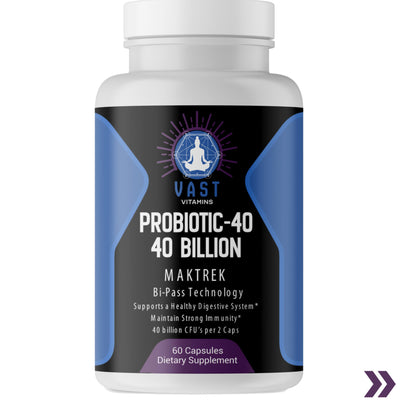
Our Probiotic 40 Billion CFU capsules use MAKtrek bi-pass technology specifically for this reason — protecting live cultures through the acidic stomach environment so they reach the colon intact.
For the gut-immune-brain triad: the gut-brain connection and the role of gut bacteria in increasing serotonin naturally extend this same logic into mood and cognitive health.
How Long Does It Take for Probiotics to Support Immunity?

This is one of the most common questions about probiotics for immune system support — and the honest answer involves multiple timeframes.
- Days: Gut barrier reinforcement (tight junction protein expression) begins within days of consistent supplementation
- 2–4 weeks: Measurable increases in secretory IgA have been observed at this point in daily-use trials
- 3+ months: The URTI-reduction outcomes measured in the Cochrane review came from trials lasting a full respiratory season
Most probiotic strains are transient — they do not permanently colonize the gut. Daily use is required to maintain active GALT interaction. This is not a flaw in the product; it reflects the mechanism. These bacteria are working continuously, not building a one-time structure. When you stop taking them, the active immune signaling diminishes within weeks.
Practical guidance: do not assess immune results after two weeks. The early changes (IgA, barrier) are real but not yet translating into fewer sick days. Give it a full season of consistent use — ideally starting before the respiratory season begins, not in the middle of it.
Try Vast Vitamins Probiotic 40 Billion CFU MAKtrek
Our probiotic capsules use MAKtrek bi-pass technology to protect live cultures through stomach acid — ensuring they reach your gut where GALT immune interaction happens.
Frequently Asked Questions
Can probiotics prevent colds and flu?
Probiotics can reduce how often you get respiratory infections and shorten their duration, but they are not guaranteed prevention. A 2022 systematic review of 16 RCTs (4,798 participants) found probiotics reduced URTI occurrence by approximately 24% and reduced duration by an average of 1.22 days. Consistent daily use over 3+ months produced the most reliable results in these trials.
How do probiotics help the immune system specifically?
Probiotics support immune function through four primary pathways: stimulating secretory IgA (your mucosal first-line defense); modulating Toll-like receptor (TLR) signaling to balance pro- and anti-inflammatory cytokines; reinforcing tight junction proteins in the gut barrier to reduce systemic inflammatory triggers; and enhancing natural killer cell and macrophage activity. All four operate simultaneously and reinforce each other.
Which probiotic strain is best for immune support?
L. rhamnosus GG and L. paracasei 8700:2/N1115 have the strongest clinical data for reducing upper respiratory infections. L. plantarum HEAL9 has shown benefit for URTI prevention in adults specifically. B. lactis HN019 is the most studied strain for natural killer cell enhancement.
For general immune support, a multi-strain formula covering both Lactobacillus and Bifidobacterium species addresses more immune pathways than any single strain.
Should I take more probiotics when I feel sick?
The protective effect of probiotics on immune function is preventative, not acute. Clinical trials showing reduced infection frequency and shorter illness duration measured outcomes after 3+ months of consistent daily use — not from dosing up at the first sign of a sniffle. Daily, consistent use builds the GALT-probiotic relationship that trains your immune system over time.
Are probiotics safe if I have a weakened immune system?

Probiotics are safe for most healthy adults, but people with significantly weakened immune systems — including those on immunosuppressant medications, undergoing chemotherapy, or hospitalized with serious illness — should consult a doctor before use. For full population-specific safety guidance, see our article on whether probiotics are safe for your situation.
How long do I need to take probiotics to see immune benefits?
Secretory IgA changes can be observed within 2–4 weeks of daily probiotic use. Gut barrier reinforcement begins within days. For the most clinically meaningful outcome — reduced upper respiratory infection frequency — trials ran 3+ months. A practical target: assess results after 8 weeks of consistent use, not after two weeks.
Do I need refrigerated probiotics for immune support?
Not necessarily. The key factor is whether live cultures survive stomach acid to reach the colon — where GALT interaction occurs. Acid-resistant encapsulation technology (like MAKtrek bi-pass) is more important than refrigeration for ensuring viable delivery.
Check the label for CFU count guaranteed at expiration, not just at manufacture — that number tells you what is actually alive when you take the capsule.
These statements have not been evaluated by the FDA. This product is not intended to diagnose, treat, cure, or prevent any disease. Always consult a qualified healthcare provider before beginning any supplement regimen, particularly if you are pregnant, nursing, taking medications, or have an underlying health condition.
Sources
- PMC9818925 — Gut microbiota and immune regulation: TLR pathways, IgA mechanism, NK cell activity, cytokine modulation (2023)
- PMC4006993 — Probiotic mechanisms and gut-associated lymphoid tissue (GALT) architecture (2014)
- PMC9400717 — Probiotics for upper respiratory tract infections: systematic review of 16 RCTs, 4,798 participants (2022 Cochrane-quality review)
- PMC8512487 — Probiotics regulate microbiota to improve immunity via TLR inhibition and barrier reinforcement (2021)
- PMC6218795 — Probiotic strains and cytokine profile modulation (2018)
- JAMA Network Open 2024 — Probiotics reduce fever duration by 1.1 days in children with upper respiratory tract infections
- NIH Office of Dietary Supplements — Probiotics — General evidence overview and safety summary
- NCCIH — Probiotics: Usefulness and Safety — Evidence context and regulatory guidance