






















D-Mannose for UTIs: What the Evidence Actually Says
Urinary tract infections send more than 8 million Americans to the doctor every year — and for the 25–30% who experience recurrent infections, finding a long-term solution that does not rely entirely on antibiotics is an urgent concern. D-mannose has emerged as one of the most popular non-antibiotic options. But does it actually work?
The honest answer is: the evidence is more complicated than most supplement articles will tell you. Early studies were genuinely promising. But a large 2024 randomized controlled trial found no statistically significant benefit over placebo. Here is what the science actually shows — and how to make an informed decision.
Key Takeaways
- D-mannose is a naturally occurring sugar that may prevent E. coli from sticking to the bladder wall
- It is most relevant for UTIs caused by E. coli, which accounts for approximately 80–90% of infections
- A large 2024 JAMA Internal Medicine trial (598 women, 99 UK primary care centers) found no statistically significant benefit over placebo for recurrent UTI prevention
- Standard dosage: 2g daily for prevention; higher doses short-term for active infections
- D-mannose is not a replacement for antibiotics if you have an active, confirmed infection — if symptoms persist beyond 24–48 hours, see a doctor
What Is D-Mannose?
D-mannose is a simple monosaccharide — a type of naturally occurring sugar — found in small amounts in fruits such as cranberries, apples, and blueberries. The human body produces trace amounts of it as well.
Structurally, it is similar to glucose, but the body metabolizes it differently. Most D-mannose you ingest is not absorbed by the intestines the way glucose is. Instead, it passes into the bloodstream and then into the urine — which is exactly the property that makes it relevant for UTI prevention.
D-mannose is available as a dietary supplement in two forms:
- Powder — dissolved in water before drinking; the form used in most clinical research
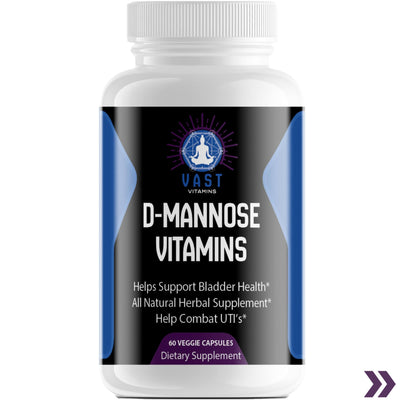
- Capsules — more convenient but less studied for dosing equivalence
One important clarification: D-mannose is not a medication. It is a dietary supplement. The FDA does not evaluate or approve it for UTI treatment, and no standardized dosage is officially sanctioned. The evidence supporting its use comes from independent clinical research, not regulatory approval.
How D-Mannose Works Against UTIs
The proposed mechanism behind d-mannose for UTIs is biologically plausible and well-described in the research literature — even if the clinical results have been mixed.
Most UTIs — roughly 80–90% — are caused by Escherichia coli (E. coli). To infect the bladder, E. coli must first attach to the bladder wall. It does this using surface appendages called type 1 pili, which are tipped with a protein called FimH. FimH binds to mannose-coated receptors on the surface of bladder epithelial cells, allowing E. coli to anchor itself and begin multiplying.
When you take D-mannose, the free mannose molecules that appear in your urine essentially give the FimH adhesin something else to grab onto. The E. coli bind to the free D-mannose in the urine instead of the bladder wall — and then get flushed out during urination. According to research published in Frontiers in Pharmacology, this is a competitive inhibition mechanism: D-mannose saturates the FimH receptor before bacteria can attach to the urothelium.
In laboratory and animal studies, mannose-based compounds reduce bacterial load in the urinary tract by two to four times. The mechanism is well-supported at the cellular level. The question is whether that translates into meaningful clinical outcomes in humans — and that is where the evidence gets complicated.
Does D-Mannose Work Only for E. coli UTIs?
This is a critical limitation that most articles gloss over: D-mannose only works against E. coli, and specifically only against E. coli that uses type 1 pili (FimH) to adhere.
UTIs caused by other bacteria — including Klebsiella pneumoniae, Staphylococcus saprophyticus, and Proteus mirabilis — account for roughly 10–20% of infections. These organisms use different adhesion mechanisms that D-mannose cannot block.
This matters in practice. Without a urine culture, you cannot know which bacteria is causing your UTI. If D-mannose is not working for you, a non-E. coli pathogen may be the reason — not dosage or timing.
Research published in Frontiers in Microbiology (2023) also found that cranberry may have broader anti-adhesion activity than D-mannose, because cranberry's proanthocyanidins (PACs) can inhibit both type 1 pili and P-type fimbriae — another adhesion mechanism used by E. coli. D-mannose, by contrast, only targets type 1 pili. This distinction has real implications for anyone choosing between the two.
What Does the Research Say?
This is the section that most supplement blogs get wrong. The evidence on d-mannose for UTIs has evolved significantly — and where it currently stands is not where it was five years ago.
Here is the honest progression:
2013 — The study that generated early optimism
A randomized trial by Kranjcec et al. (PMID: 23633128) enrolled 308 women with recurrent UTIs and compared 2g of D-mannose powder daily to 50mg nitrofurantoin daily or no prophylaxis over 6 months. The D-mannose group had a 14.6% recurrence rate vs. 20.4% for nitrofurantoin and 60.8% for no treatment. The conclusion: D-mannose appeared comparable to antibiotic prophylaxis.
This single study did more to establish D-mannose's reputation than almost anything else. For a decade, it was the central citation in nearly every positive article.
2022 — The Cochrane review pours cold water
The 2022 Cochrane systematic review pooled data from seven randomized trials (719 participants total). Its conclusion was stark: the available evidence was of very low certainty, and no two studies were comparable enough to pool in a meta-analysis. The review called for an adequately powered, placebo-controlled trial to settle the question.
2024 — The definitive large-scale trial arrives
The 2024 JAMA Internal Medicine randomized controlled trial was exactly what the Cochrane review called for — and the results were sobering. Conducted across 99 primary care centers in the UK, 598 women with recurrent UTIs were randomized to either 2g daily D-mannose powder or matched placebo for 6 months.
- D-mannose group: 51.0% experienced a recurrent UTI
- Placebo group: 55.7% experienced a recurrent UTI
- Risk difference: −5% (95% CI, −13% to 3%; p = 0.26)
- No statistically significant differences in any secondary outcomes
The trial authors concluded: "d-Mannose should not be recommended to prevent future episodes of medically attended UTI in women with recurrent UTI in primary care."
What this means for you
The current body of evidence does not support D-mannose as a reliable strategy for preventing recurrent UTIs. It is well-tolerated and carries low risk, which means it may still be worth discussing with your doctor — but it should not replace evidence-based approaches like behavioral modifications, topical estrogen (for postmenopausal women), or antibiotic prophylaxis where clinically appropriate. For a deeper look at that comparison, see our post on how D-mannose compares to antibiotics for UTI treatment.
Why Early Studies Looked More Promising
This is not an indictment of D-mannose — it reflects normal scientific progress.
Many early studies enrolled participants from specialist urology or gynecology clinics. These patients were more likely to have confirmed E. coli infections, since complex or recurrent cases often have culture data. A supplement that only works against E. coli would naturally perform well in a population confirmed to have E. coli.
The 2024 JAMA trial recruited from primary care — a more representative, unselected population where many participants may have had non-E. coli infections, subclinical issues, or other confounding factors. Larger, better-designed trials often revise earlier findings downward. That is science working correctly, not a failure.
D-Mannose Dosage for UTIs
There is no FDA-approved dosage for D-mannose. The protocols below come from clinical study designs — they are what researchers used, not official medical guidelines. Always discuss dosing with your healthcare provider before starting.
Dosage for Prevention (Recurring UTIs)
The most widely studied prevention protocol is 2 grams once daily — the exact dose used in both the Kranjcec 2013 trial and the 2024 JAMA trial. Some sources suggest 1 gram twice daily as an equivalent alternative.
Key details for prevention use:
- Taken continuously over weeks to months (most studies ran for 6 months)
- D-mannose powder dissolved in water is the form used in research; capsule equivalence is less studied
- The 2024 JAMA trial used 2g daily and found no significant benefit over placebo — factor this into your decision-making
- If you want more detail on dosing options, our D-Mannose supplement label includes usage guidance
Dosage for an Active UTI
Some protocols have been used for active infection management, though D-mannose is not proven to resolve an active UTI and should not replace a medical evaluation:
- 1.5 grams twice daily for 3 days, then once daily for 10 days (one commonly cited protocol)
- 1 gram three times daily for 14 days (from a 2014 pilot study)
A critical caveat: if you have an active UTI and delay antibiotic treatment while trying D-mannose, you risk the infection ascending from the bladder to the kidneys. Pyelonephritis (kidney infection) is a serious medical emergency. If your symptoms have not improved within 24–48 hours, see a doctor. Do not attempt to self-treat a suspected UTI with D-mannose alone.
Side Effects and Safety
One area where D-mannose genuinely holds up is tolerability. Across clinical studies, it has a favorable safety profile compared to long-term antibiotic prophylaxis.
Most common side effects:
- Loose stools or diarrhea
- Bloating or mild gastrointestinal upset
- These are typically mild and resolve on their own
Considerations for specific groups:
- Diabetes: D-mannose is a sugar. While most study doses appear to have minimal blood glucose impact, people with diabetes or insulin resistance should use caution and monitor blood sugar. Consult your doctor before use.
- Pregnancy and breastfeeding: Insufficient evidence exists to confirm safety. Avoid use unless specifically approved by your healthcare provider.
- Long-term use: Safety data beyond 6 months is limited. The 2024 JAMA trial is the longest major study to date.
- Drug interactions: No major interactions with common medications are well-documented, but always inform your doctor of any supplements you take — especially during an active infection when you may also be taking antibiotics.
The relative safety of D-mannose is one reason some clinicians are comfortable suggesting it as a low-risk adjunctive option, even in the absence of strong efficacy evidence.
D-Mannose vs. Cranberry for UTIs
Both D-mannose and cranberry aim to prevent E. coli from sticking to the bladder wall, but they work through different mechanisms — and the comparison is not as equal as many articles suggest.
D-mannose: targets only type 1 pili (FimH adhesin) in E. coli. It works by competitive inhibition in the urine.
Cranberry proanthocyanidins (PACs): may inhibit both type 1 pili and P-type fimbriae — a broader range of E. coli adhesion proteins. A 2023 study published in Frontiers in Microbiology found that cranberry (but not D-mannose) demonstrated a protective effect against uropathogenic E. coli-induced cell damage in urinary epithelial cells.
Neither is a proven antibiotic-replacement. Neither reliably clears a confirmed active infection. Some formulations combine both — but research on combination products is still preliminary.
A full evidence-based comparison of D-mannose and cranberry for UTI prevention is coming soon on this site.
When to See a Doctor Instead
D-mannose is not an antibiotic. It does not kill bacteria — it only attempts to prevent adhesion. This distinction is critical for knowing when to stop relying on it and seek medical care.
See a doctor immediately if you experience any of the following:
- Fever, chills, or shaking — may indicate a kidney infection
- Back or flank pain (pain below your ribs, on either side of your spine)
- Nausea or vomiting alongside urinary symptoms
- Blood in your urine
- Symptoms in a child, a man, a pregnant woman, or anyone who is immunocompromised
- Symptoms that have not improved after 24–48 hours of taking D-mannose
- Symptoms recurring more than twice in the past 6 months
D-mannose may be considered as a supplementary preventive measure in discussion with your healthcare provider — not as a substitute for medical evaluation when you have an active infection.
Frequently Asked Questions
How long does d-mannose take to work for a UTI?
D-mannose passes through the body and appears in urine within 30–60 minutes of ingestion. In smaller pilot studies, over 90% of participants reported symptom improvement within 3 days of starting treatment. However, if your symptoms have not improved within 24–48 hours, seek medical attention — delaying antibiotic treatment can allow an infection to spread to the kidneys, which requires urgent care.
Can you take d-mannose every day for UTI prevention?
Most clinical studies ran daily D-mannose for up to 6 months without significant safety concerns. The most common side effect with daily use is mild digestive upset. However, the 2024 JAMA Internal Medicine trial found no statistically significant benefit of daily D-mannose over placebo for preventing recurrent UTIs. Discuss the risk-benefit balance with your doctor before committing to long-term daily use, especially given the current evidence.
Does d-mannose work for all types of UTIs?
No. D-mannose works by blocking the FimH adhesion protein used by E. coli — which causes approximately 80–90% of UTIs. It is unlikely to be effective against UTIs caused by other bacteria such as Klebsiella pneumoniae, Staphylococcus saprophyticus, or Proteus mirabilis. A urine culture is the only reliable way to confirm which bacteria is causing your infection.
Is d-mannose safe to take with antibiotics?
No major drug interactions between D-mannose and antibiotics are currently documented. Some clinicians suggest D-mannose may complement antibiotic treatment, though the combination has not been rigorously studied in clinical trials. Always inform your doctor about any supplements you are taking, especially during an active infection.
Can men take d-mannose for UTIs?
Most clinical evidence for D-mannose comes from studies conducted exclusively in women. UTIs in men are less common and more frequently associated with underlying structural or prostate issues — they warrant prompt medical evaluation regardless of supplement use. D-mannose has not been adequately studied in men for UTI prevention or treatment, so there is insufficient evidence to make a reliable recommendation.
What is the difference between d-mannose powder and capsules?
The majority of clinical trials — including both the 2013 Kranjcec study and the 2024 JAMA trial — used D-mannose in powder form dissolved in water. Capsules are more convenient, but dosing equivalence between powder and capsule forms has not been independently verified. If you are following a specific study protocol (such as 2g daily), verify that your capsule dose matches before substituting powder for capsules.
These statements have not been evaluated by the Food and Drug Administration. This product is not intended to diagnose, treat, cure, or prevent any disease. The information in this article is for educational purposes only and is not a substitute for professional medical advice. Always consult your healthcare provider before starting any new supplement, especially if you have a medical condition or are pregnant.
Sources
- Nicolle LE et al. d-Mannose for Prevention of Recurrent Urinary Tract Infection Among Women: A Randomized Clinical Trial. JAMA Internal Medicine, 2024. jamanetwork.com | PMC11002776
- Cooper TE et al. D-mannose for preventing and treating urinary tract infections. Cochrane Database of Systematic Reviews, 2022. Cochrane Library | PMC9427198
- Lenger SM et al. D-mannose vs other agents for recurrent urinary tract infection prevention in adult women: a systematic review and meta-analysis. American Journal of Obstetrics & Gynecology, 2020. PMC7395894
- Kranjcec B et al. D-mannose powder for prophylaxis of recurrent urinary tract infections in women: a randomized clinical trial. World Journal of Urology, 2014 (published online 2013). PMID 23633128
- Domenici L et al. Why D-Mannose May Be as Efficient as Antibiotics in the Treatment of Acute Uncomplicated Lower Urinary Tract Infections. PMC, 2022. PMC8944421
- Sihra N et al. Nonantibiotic prevention and management of recurrent urinary tract infection. Nature Reviews Urology / Springer, 2022. Springer Nature
- Tay WH et al. Cranberry, but not D-mannose and ibuprofen, prevents against uropathogenic Escherichia coli-induced cell damage and cell death in MDCK cells. Frontiers in Microbiology, 2023. Frontiers in Microbiology