














BCAA Supplement Benefits: What the Science Actually Says

A 2024 systematic review of systematic reviews found that BCAA supplementation reduces post-exercise creatine kinase — a marker of muscle damage — with medium effect sizes, and reduces muscle soreness with small but meaningful effect sizes. That is a genuinely useful result. But BCAAs are also one of the most overhyped supplements on the market, and what science supports is more specific than most brand blogs will tell you.
This guide covers what BCAA supplements actually do, who benefits most, the honest answer to whether you need them, how much to take, and the safety considerations most supplement articles skip.
Key Takeaways
- BCAAs (leucine, isoleucine, valine) are best supported by evidence for reducing post-workout soreness and preventing muscle breakdown — not for building muscle from scratch.
- If you already hit your daily protein target from food or a complete protein powder, a separate BCAA supplement is unlikely to add significant muscle-building benefit.
- ALS patients should not take BCAA supplements — this is a hard contraindication supported by clinical trial evidence, not a precaution to take lightly.
What Are BCAAs?
Branched-chain amino acids are three essential amino acids — leucine, isoleucine, and valine — named for the branching structure of their molecular side chains. "Essential" means the body cannot synthesise them; they must come from food or supplements.
What makes BCAAs distinct from most other amino acids is where they are metabolised. Rather than being processed primarily in the liver, BCAAs are metabolised directly in skeletal muscle tissue. This gives them a unique and direct role in exercise physiology that most other amino acids do not share.
BCAAs make up approximately 35% of the essential amino acids in muscle protein and account for a significant proportion of the amino acids the body requires daily. Common dietary sources include:
- Eggs and dairy products (some of the richest sources)
- Meat, poultry, and fish
- Legumes (lower but meaningful amounts)
Most people consuming adequate total protein from food are already getting sufficient BCAAs from their diet. This matters when we discuss whether supplementation adds benefit — which we will cover directly.
Proven Benefits of BCAA Supplements

Evidence varies significantly by benefit. Some applications have strong clinical support; others are promising but limited in scope. Here is an honest breakdown.
Evidence rating key: ★★★ = multiple high-quality RCTs with consistent results | ★★☆ = solid evidence with some caveats | ★☆☆ = emerging evidence, shows promise but needs more research
Muscle Recovery and Reduced DOMS ★★★ (Strong Evidence)
This is the best-supported benefit of BCAA supplementation. BCAAs taken around training consistently reduce delayed onset muscle soreness (DOMS) — the deep ache that sets in 12–72 hours after intense exercise.
A 2024 systematic review of systematic reviews confirmed that BCAA supplementation reduces post-exercise creatine kinase levels (a direct marker of muscle damage) with a medium effect size, and reduces perceived muscle soreness with a small but consistent effect size. An earlier 2021 meta-analysis found similar attenuation of muscle damage markers specifically in trained males after resistance exercise.
The mechanism: BCAAs blunt the muscle protein breakdown response to exercise, reducing the inflammatory cascade responsible for soreness. They do not prevent the training stimulus — they reduce the collateral damage.
Prevention of Muscle Breakdown ★★★ (Strong Evidence)
BCAAs are strongly anti-catabolic — they reduce muscle protein breakdown (proteolysis) during calorie restriction, fasted training, and prolonged endurance exercise.
This is actually the clearest case where BCAAs add value even for someone already eating enough protein. During fasted cardio, in a calorie deficit, or in the later stages of a long endurance session, blood amino acid availability drops. BCAAs can blunt the catabolic response in these specific windows.
Leucine in particular activates the mTORC1 signalling pathway, which initiates muscle protein synthesis — though note the important limitation in the next section on whether BCAAs alone can actually complete that synthesis response.
A 2023 review confirmed that BCAAs transiently stimulate muscle protein synthesis and reduce muscle protein breakdown, while noting that the magnitude of the anabolic response is less than that achieved with a complete protein source.
Reducing Exercise Fatigue ★★☆ (Moderate Evidence)
The central fatigue hypothesis is well-established in sports nutrition: during prolonged exercise, blood BCAA levels drop. This allows more tryptophan — which competes with BCAAs for entry across the blood-brain barrier — to enter the brain and be converted to serotonin, contributing to the feeling of fatigue.
BCAA supplementation maintains blood BCAA levels, potentially delaying this mechanism and extending time-to-fatigue. Evidence is moderate — most well-controlled trials show meaningful effects in endurance exercise (especially sessions lasting two hours or more) but more modest effects in short-duration resistance training.
A 2022 systematic review found BCAAs improve aerobic capacity and reduce central fatigue markers in athletes. For context on reducing exercise fatigue naturally, BCAAs represent one approach among several nutritional strategies.
Liver Health Support ★★☆ (Moderate Evidence — Clinical Context)
This benefit applies specifically to people with liver cirrhosis, not the general population. BCAAs are often severely depleted in cirrhosis patients; supplementation is a well-established part of clinical nutritional support in this population.
A 2024 propensity-matched cohort study found BCAA supplementation was associated with significantly lower rates of hepatic encephalopathy, spontaneous bacterial peritonitis, and emergency room visits in cirrhosis patients.
If you have liver disease and are considering BCAAs, this is a conversation to have with your physician — clinical dosing in this context differs from athletic supplementation.
Muscle Loss Prevention During Illness or Immobilisation ★★☆ (Moderate Evidence)
BCAAs may reduce muscle atrophy during periods of bed rest, injury recovery, illness, or surgical convalescence — situations where dietary protein intake is often compromised and muscle wasting can accelerate quickly.
A comprehensive 2018 overview of BCAAs in health and disease outlined both the athletic and clinical contexts where BCAA supplementation may slow the rate of lean mass loss when protein intake is suboptimal.
The Honest Answer — Do You Actually Need a BCAA Supplement?

Most supplement blogs avoid this question because an honest answer might reduce sales. We are not going to do that.
If you already consume adequate total protein — roughly 1.6–2.2 g/kg of bodyweight per day from food or a complete protein supplement — a standalone BCAA supplement is unlikely to add significant muscle-building benefit.
Here is why. A 2017 systematic review by Wolfe concluded that the claim BCAAs alone produce a net anabolic effect in muscle "is unwarranted" without the full complement of essential amino acids. Muscle protein synthesis requires all nine essential amino acids. BCAAs can initiate the signalling cascade via leucine, but if the other essential amino acids are not available, the synthesis process cannot complete. You get a partial stimulus, not a full one.
Whey protein, by comparison, contains approximately 25% BCAAs by weight — so if you take whey protein post-workout, you are already getting BCAAs as part of a complete amino acid package. A separate BCAA supplement on top is likely redundant. Pairing your training nutrition with a complete protein supplement like whey covers your BCAA needs and then some.
That said, BCAAs make sense as a standalone supplement in specific situations:
- Fasted training or intermittent fasting: If you train in a fasted state and do not want to break a fast with a full protein shake, BCAAs provide amino acid support with minimal caloric disruption.
- Plant-based diets: Getting adequate leucine in particular can be harder from plant sources alone; BCAAs can help fill the gap.
- Competitive endurance athletes: During very long sessions (2+ hours), BCAA supplementation has meaningful evidence for reducing fatigue and muscle catabolism in a way that may not be practical to replace with food.
- Calorie deficit phases: When cutting calories, BCAAs can help preserve lean muscle beyond what your reduced protein intake alone supports.
- Clinical liver disease: Under medical supervision, as discussed above.
A complete nutritional approach — including energy-supporting supplements like B12 alongside adequate protein — generally serves most people better than adding BCAAs to an already adequate diet.
BCAA Dosage — How Much to Take

Dosage varies by goal and bodyweight. Here is what the research typically supports:
| Goal | Studied Dose | Timing | Duration |
|---|---|---|---|
| Reduce DOMS / muscle soreness | 5–10 g | Around training (pre, intra, or post) | Consistent supplementation; acute single doses also effective |
| Prevent muscle breakdown (fasted training) | 5–10 g | 15–30 minutes before fasted cardio | As needed during calorie deficit phases |
| Endurance fatigue reduction | 10–20 g | During prolonged exercise (2+ hours) | Per session |
| Liver cirrhosis (clinical) | Per physician guidance | As directed | Ongoing; clinical supervision required |
Additional notes:
- Bodyweight approach: 0.05–0.1 g of BCAAs per kg of bodyweight per serving is a commonly cited range in the research literature.
- The leucine threshold: Research suggests approximately 2–3 g of leucine per dose is required to maximally stimulate the mTORC1 pathway and initiate muscle protein synthesis. Check that your serving size meets this threshold.
- Ratio matters: A 2:1:1 ratio of leucine to isoleucine to valine is the most studied and most commonly used in clinical trials.
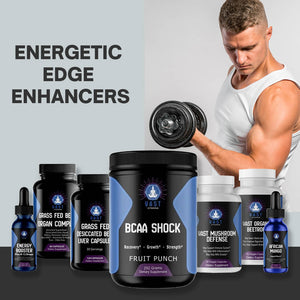
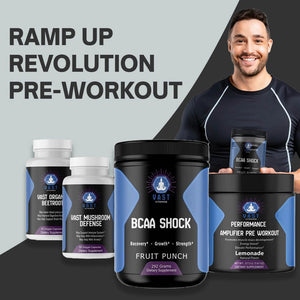
For a powder form that delivers 5,000mg of BCAAs in a 2:1:1 ratio — within these evidence-based ranges — BCAA SHOCK powder is designed to be mixed in 8–10 oz of cold water and taken pre-workout or around training.
Safety and Side Effects

General Safety
BCAAs are well-tolerated for most healthy adults at typical supplement doses. The most common side effect is digestive discomfort — bloating, nausea, or stomach upset — which is more likely when BCAAs are taken on an empty stomach. Taking them with a small amount of food or mixing them in a larger volume of liquid usually resolves this.
Long-term data at high doses is limited; staying within the ranges studied in clinical literature (5–20 g/day) is the prudent approach. A review of amino acid supplement side effects found no significant safety concerns at typical athletic doses in healthy individuals.
Who Should Avoid BCAAs
Several populations should either avoid BCAAs entirely or only use them under medical supervision:
- ALS (amyotrophic lateral sclerosis): BCAAs are contraindicated in ALS. A double-blind clinical trial was halted early after the BCAA group showed a significantly higher rate of lung function decline and excess mortality compared to placebo. This is not a precaution — it is a hard stop. If you or someone you know has ALS, do not use BCAA supplements.
- Pregnancy and breastfeeding: Safety data is insufficient. At least one animal study suggests high maternal BCAA intake may affect fetal and placental development. During pregnancy, stick to food sources of amino acids and avoid concentrated BCAA supplements.
- Diabetes or blood sugar medication: BCAAs may lower blood glucose, which can compound the effect of diabetes medications and create hypoglycemia risk. If you take medication for blood sugar management, consult your physician before starting BCAA supplementation and monitor glucose levels closely.
- Maple Syrup Urine Disease (MSUD): This rare genetic condition impairs BCAA metabolism. BCAAs must be strictly avoided.
Consult Your Doctor If...
Talk to a healthcare provider before starting BCAA supplementation if any of the following apply:
- You take diabetes medication, thyroid medication, or Parkinson's disease medications (potential interactions documented with all three)
- You have a chronic liver condition (clinical dosing differs significantly from athletic dosing)
- You are pregnant, breastfeeding, or planning to become pregnant
- You have ALS or any neurodegenerative condition
Try Vast Vitamins BCAA SHOCK
BCAA SHOCK delivers 5,000mg of branched-chain amino acids in a 2:1:1 leucine-forward ratio — designed to support muscle recovery and reduce soreness when taken around training.
Frequently Asked Questions
What are BCAA supplements used for?
BCAAs are most commonly used to reduce post-workout muscle soreness, prevent muscle breakdown during calorie deficits or fasted training, and support recovery from intense exercise. Clinical populations also use them for liver disease management and muscle wasting prevention during illness — but these are medical contexts requiring physician guidance.
Do BCAAs actually help build muscle?
BCAAs alone cannot maximally stimulate muscle protein synthesis because all nine essential amino acids must be present for synthesis to complete. A 2017 systematic review concluded the claim that BCAAs produce a net anabolic response "is unwarranted" without the full complement of EAAs. For muscle building, a complete protein source like whey is substantially more effective than BCAAs alone.
When is the best time to take BCAAs?
Around training — pre-, intra-, or post-workout all show benefit in the research. For fasted training specifically, taking BCAAs 15–30 minutes before the session is a well-supported approach: you get anti-catabolic protection without a full meal that would break a fast.
How much BCAA should I take per day?
Most research uses 5–20 g/day depending on bodyweight and goal. For most people focused on recovery and soreness, 5–10 g around training is effective. Endurance athletes during long sessions may benefit from higher amounts (up to 20 g). A bodyweight-based approach of 0.05–0.1 g/kg per serving is a practical starting point.
Are BCAAs safe to take every day?
For most healthy adults, yes — daily BCAA supplementation at typical doses is generally considered safe. However, people with ALS, diabetes, Maple Syrup Urine Disease, or those who are pregnant should avoid BCAAs or consult a physician. People taking thyroid, Parkinson's, or diabetes medications should also check with a doctor first due to documented interactions.
Do I need BCAAs if I already take whey protein?
Probably not. Whey protein contains approximately 25% BCAAs by weight, providing substantial branched-chain amino acids within a complete essential amino acid package. If you are hitting your daily protein targets with whey, a separate BCAA supplement is unlikely to add meaningfully to your recovery or muscle-building results.
Can BCAAs help with weight loss?
BCAAs are not a fat-burning supplement — they do not directly stimulate fat oxidation. However, research suggests they may help preserve lean muscle mass during calorie restriction, which matters for body composition: retaining more muscle while losing fat produces better long-term metabolic outcomes than losing both. Think of them as muscle-preservation support during a cut, not a weight loss tool in isolation.
These statements have not been evaluated by the Food and Drug Administration. This product is not intended to diagnose, treat, cure, or prevent any disease.
Consult your healthcare provider before starting any new supplement, especially if you have a medical condition, take prescription medication, or are pregnant or breastfeeding.
References
- Gee TI, et al. (2024). Branched-Chain Amino Acids Supplementation and Post-Exercise Recovery: An Overview of Systematic Reviews. Journal of Human Kinetics. PubMed PMID 38241335.
- Fouré A, Bendahan D. (2017). Is Branched-Chain Amino Acids Supplementation an Efficient Nutritional Strategy to Alleviate Skeletal Muscle Damage? A Systematic Review. Nutrients. PubMed PMID 28934166.
- Wolfe RR. (2017). Branched-chain amino acids and muscle protein synthesis in humans: myth or reality? Journal of the International Society of Sports Nutrition. PubMed PMID 28852372.
- Wolfe RR. (2023). The effects of branched-chain amino acids on muscle protein synthesis, muscle protein breakdown and associated molecular signalling responses in humans: an update. Nutrition Research Reviews. PubMed PMID 37681443.
- Bifari F, Nisoli E. (2018). Branched-chain amino acids revisited: new roles within and beyond the muscle. The FEBS Journal. PubMed PMID 29755574.
- Gu Y, et al. (2024). BCAA supplementation and outcomes in liver cirrhosis: propensity-matched cohort study. PubMed PMID 40762759.
- Martinho DV, et al. (2022). Oral Branched-Chain Amino Acids Supplementation in Athletes: A Systematic Review. Nutrients. PMC9571679.
- Zanchi NE, et al. (2021). BCAA supplementation and muscle damage markers: meta-analysis of resistance exercise. PubMed PMID 34072718.
- Review of amino acid supplement side effects. (2022). PMC8997670.
- WebMD. (2024). Branched-Chain Amino Acids: Uses, Side Effects, Interactions, Dosing. webmd.com.
- Examine.com. Branched-Chain Amino Acids — Research Analysis. examine.com.