



















Ashwagandha and Black Pepper: Does the Combination Actually Work?

Key Takeaways
- Ashwagandha works without black pepper, but piperine (black pepper's active compound) enhances absorption of its active withanolides by inhibiting key digestive enzymes — potentially making each dose more effective.
- The effective piperine dose in published studies is 5–20 mg per serving — check your supplement label, as many budget formulas contain only 2–3 mg.
- Piperine can significantly increase blood levels of certain prescription medications via CYP3A4 inhibition. If you take statins, blood pressure drugs, immunosuppressants, or anticoagulants, consult your doctor before using a piperine-containing supplement.
Most ashwagandha black pepper supplements now combine these two botanicals — but few labels explain why. The answer comes down to a fundamental challenge with ashwagandha: its active compounds, the withanolides, are not optimally absorbed on their own. Piperine, the alkaloid that gives black pepper its heat, helps solve that problem. And the science behind it is more interesting than most supplement labels let on.
Before diving into the mechanism, let's answer the question most people are actually asking.
Does ashwagandha need black pepper to work? No. Clinical trials have confirmed significant stress, cortisol, and sleep benefits from ashwagandha taken without piperine. However, combining the two enhances the bioavailability of ashwagandha's active withanolides — meaning more reaches your bloodstream with each dose. Most quality formulas include it for this reason.
What Is Ashwagandha? (A Brief Overview)
Ashwagandha (Withania somnifera) is a root herb with a documented place in Ayurvedic medicine stretching back approximately 2,000–3,000 years — not the "AD 6000" figure sometimes seen in older supplement marketing, which conflates mythology with history.
Its active compounds are withanolides — a family of steroidal lactones concentrated in the root. Two of the most studied are withanolide A and withaferin A, which appear to drive much of the herb's adaptogenic activity.
Ashwagandha's primary mechanism involves modulating the HPA (hypothalamic-pituitary-adrenal) axis — the hormonal cascade that governs your body's stress response and controls cortisol secretion from the adrenal glands. Some researchers also propose a GABAergic component to its calming effects, where ashwagandha may mimic GABA activity at certain receptor sites, though this is based primarily on preclinical models and has not been fully confirmed in humans.
Clinically, the most-studied forms are KSM-66 (a root-only extract standardized to 2.5% withanolides) and Sensoril (a root-and-leaf extract standardized to 10%). Both outperform unstandardized powders in clinical research.
For a full breakdown of ashwagandha's proven benefits across stress, sleep, cognition, and performance, see our complete ashwagandha benefits guide.
The Bioavailability Problem — Why Ashwagandha's Active Compounds Are Hard to Absorb

Bioavailability refers to the proportion of an ingested compound that actually enters circulation and becomes available for use. For ashwagandha, this is where things get complicated.
Not all withanolides absorb equally. Research published in PMC4630722 found that nonpolar withanolides — including withanolide A and withanone — show reasonably good intestinal permeability. But glycosylated forms like withanosides IV and V have low intestinal permeability, meaning a meaningful portion of a standard dose may never cross the gut wall effectively.
And that's just the absorption step. After withanolides are absorbed in the intestine, they face a second barrier: first-pass metabolism. Liver enzymes — particularly CYP3A4 — break down these compounds before they can circulate to target tissues, further reducing the effective dose reaching your bloodstream.
This is not unique to ashwagandha. Curcumin, coenzyme Q10, and many other botanical compounds face the same problem. The shared solution: a bioenhancer.
How Piperine Solves the Absorption Problem
Piperine is the alkaloid that makes black pepper pungent, and it is one of the best-studied natural bioenhancers — compounds that increase the absorption of other substances when taken together.
It works through two complementary mechanisms:
- Enzyme inhibition: Piperine inhibits CYP3A4 and UDP-glucuronyl transferase enzymes in the liver — the same enzymes that break down withanolides during first-pass metabolism. With those enzymes slowed, more of the active compounds survive long enough to enter circulation.
- Enhanced gut permeability: Piperine increases intestinal blood flow and the permeability of gut absorptive cells, improving uptake of compounds before they even reach the liver.
What does the data actually show? A comprehensive bioenhancer review (PMC3458266) found that 20 mg piperine increased curcumin bioavailability by 200% in human volunteers, and improved CoQ10 area under the curve (AUC) by approximately 30% with 21-day supplementation. Direct pharmacokinetic data for the ashwagandha-piperine combination specifically is more limited, but the enzyme-inhibition mechanism is the same.
The effective dose from published research: 5–20 mg piperine per serving. The FDA lists piperine as Generally Recognized as Safe (GRAS) at this range. BioPerine — a standardized extract at 95% piperine — is the commercial form most commonly used in clinical research, including the 2023 Liebertpub RCT combining standardized ashwagandha root extract with piperine for anxiety and depression.
Benefits of Ashwagandha with Black Pepper

The benefits of this combination come from two sources: ashwagandha's well-established adaptogenic effects, and piperine's potential to amplify them by improving how much reaches your bloodstream. Here is what the evidence shows across the most-studied areas.
Stress and Anxiety Relief ★★★
This is ashwagandha's strongest and most consistent evidence base. Across multiple randomized controlled trials, daily ashwagandha supplementation significantly reduces both objective cortisol levels and subjective stress and anxiety scores.
- A 2024 meta-analysis (PMC12242034) covering multiple RCTs found ashwagandha produced a mean cortisol reduction of -2.58, a Perceived Stress Scale (PSS) improvement of -4.72, and a Hamilton Anxiety Rating (HAM-A) improvement of -2.19 compared to placebo.
- A 2019 KSM-66 RCT (PMC6750292) using 240 mg/day for 60 days found cortisol reduced by 22.2% compared to placebo, with significant reductions in self-reported stress.
- An earlier 2012 RCT (PMC3573577) using 300 mg twice daily for 60 days reported PSS reductions of 44% and cortisol reductions of 27.9%.
The American Psychological Association's 2024 Stress in America survey found that 69% of adults cited significant national stressors affecting their daily wellbeing — context that helps explain why interest in adaptogenic support has grown steadily. Ashwagandha's cortisol-regulating effects are among the more evidence-supported options in this category.
Some researchers propose that ashwagandha's calming effects also involve mimicking GABA activity at certain neuroreceptor sites, contributing to its anxiolytic profile beyond HPA axis modulation. This mechanism is supported primarily by preclinical data, but it may help explain why the herb affects mood in ways that go beyond simple cortisol reduction.
One important caveat: ashwagandha is not a replacement for therapy or medical care for diagnosed anxiety disorders. For situational or stress-related anxiety in otherwise healthy adults, the evidence is encouraging. For clinical anxiety, it should be discussed with a healthcare provider as a complement to — not a substitute for — established treatments. For more on supplements in this category, see our guide to the best supplements for anxiety.
Sleep Quality ★★◄
Evidence supports ashwagandha's ability to improve sleep latency, total sleep time, and subjective sleep quality — particularly in people with diagnosed insomnia or poor baseline sleep. The effect is more modest in healthy sleepers with no pre-existing sleep issues.
The most effective studied dose for sleep: 600 mg/day for 8+ weeks, as confirmed in the NIH Office of Dietary Supplements fact sheet. Consistency matters — sleep improvements in clinical trials are typically measured at week 8, not week 2.
For a complete look at ashwagandha's effects on sleep — including timing and dose strategies — see our ashwagandha for sleep guide.
Cognitive Function and Memory ★★◄
Emerging research suggests ashwagandha may support memory, attention, and processing speed — primarily in stressed adults, where the cognitive burden of chronic cortisol elevation is the likely target.
A 2017 RCT (PubMed 28471731) using 300 mg twice daily for 8 weeks found significant improvements across Wechsler Memory Scale measures — including immediate memory, general memory, executive function, sustained attention, and processing speed — compared to placebo.
Some preclinical research has also explored ashwagandha's neuroprotective properties, including potential recovery from stress-related cognitive impairment, though human evidence in this area remains limited. These findings from animal models (PMC10147008) are mechanistically interesting but should not be overstated.
The clearest practical takeaway: if stress-driven cognitive fog is the problem, ashwagandha's cortisol-reducing effects may deliver downstream cognitive benefits. Effects in healthy, non-stressed adults are less established.
Additional Areas of Research ★★◄
Beyond its primary stress-and-sleep applications, ashwagandha has attracted preliminary research interest in several other areas worth knowing about — with appropriate expectations for the evidence level.
Blood sugar and insulin sensitivity: Some research suggests ashwagandha may support healthy blood sugar regulation by improving insulin sensitivity in muscle cells. Multiple studies have noted this effect in both healthy individuals and those with metabolic concerns, though evidence in this area remains preliminary and is not specific to the black pepper combination.
Cardiovascular markers: Early research has examined ashwagandha's potential effects on cholesterol levels and cardiovascular function, including blood pressure and lipid profiles, though this evidence base is considerably thinner than the stress and sleep literature.
Lifestyle context: Like most adaptogens, ashwagandha produces the most meaningful results when combined with consistent sleep, stress management, and a balanced diet. It is most effective as part of an overall stress-management routine — not as a standalone fix for lifestyle-related health issues.
Dosage — How Much Ashwagandha and Black Pepper to Take

There is no single FDA-approved dosage for ashwagandha. Clinical research provides the reference range most practitioners and formulators use.
| Goal | Ashwagandha Dose | Black Pepper (Piperine) | Study Duration |
|---|---|---|---|
| Stress / anxiety | 300–600 mg/day | 5–20 mg piperine | 8–12 weeks |
| Sleep quality | 600 mg/day | 5–20 mg piperine | 8+ weeks |
| Cognitive support | 300–600 mg/day | 5–20 mg piperine | 8 weeks |
| Athletic performance | 500–600 mg/day | 5–20 mg piperine | 8–12 weeks |
A few things to check on your supplement label:
- Extract standardization: Look for root extract standardized to withanolides (typically 2.5–5%). Unstandardized root powder lacks the guarantee of active compound concentration that standardized extracts provide. KSM-66 and Sensoril are the two most-studied branded formats.
- Piperine dose: Many budget supplements include only 2–3 mg of piperine per serving — well below the 5–20 mg range used in published bioavailability and clinical research. Check the label before assuming you are getting a meaningful dose.
- Timing: Morning dosing is associated with stress and energy goals; evening dosing for sleep. In practice, consistency of daily intake matters more than the specific time of day.
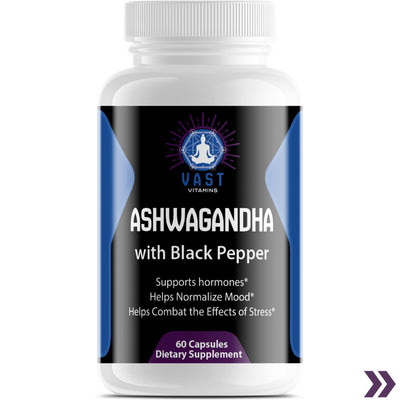
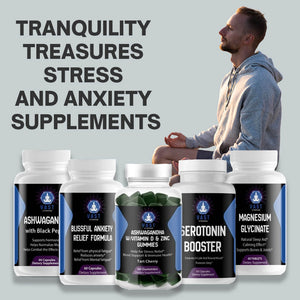
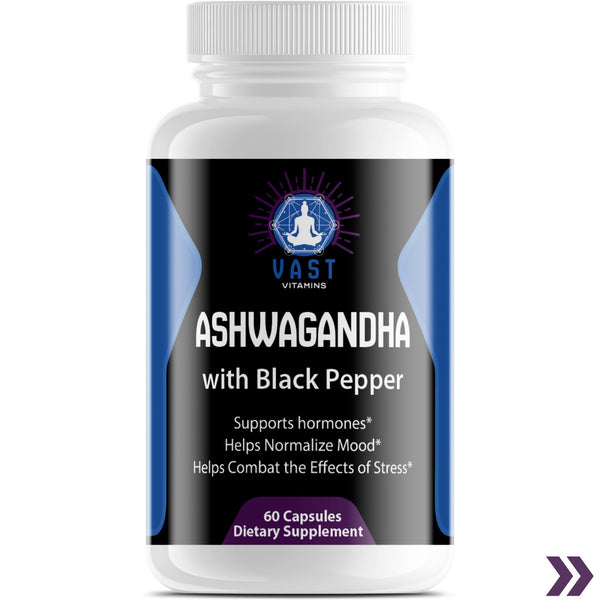
Vast Vitamins' Ashwagandha 1300mg capsules combine a high-potency root extract with black pepper extract — a clinically studied pairing formulated to support optimal absorption.
Safety and Side Effects — Including the Piperine Drug Interaction Risk
Ashwagandha is generally well tolerated at 300–600 mg/day for periods up to 3 months. Most side effects are mild and GI-related.
Common side effects:
- GI upset or loose stools (more common at higher doses or on an empty stomach)
- Drowsiness (particularly at doses above 600 mg/day)
- Occasional mild headache
Populations who should avoid ashwagandha entirely:
- Pregnant individuals: Ashwagandha should not be used during pregnancy. Evidence suggests it may cause miscarriage. This warning applies regardless of whether the formula includes black pepper. If you are pregnant or planning to conceive, consult your healthcare provider before using any adaptogenic supplement.
- Autoimmune conditions (lupus, rheumatoid arthritis, multiple sclerosis): Ashwagandha may stimulate immune activity, which could exacerbate these conditions. Consult a physician first.
- Thyroid conditions: Some evidence suggests ashwagandha affects thyroid hormone levels — relevant for individuals on thyroid medication.
Long-term safety: Safety beyond 3 months has not been established in clinical trials. Cycling — 8–12 weeks on, followed by a 2–4 week break — is sometimes recommended as a precautionary approach.
Piperine and Drug Interactions: An Important Warning

This is the safety gap that nearly every competitor article ignores — and it matters.
Piperine is a CYP3A4 inhibitor. CYP3A4 is a liver enzyme responsible for metabolizing a wide range of prescription medications. When piperine inhibits this enzyme, drug concentrations in the bloodstream can rise significantly — sometimes into ranges that cause side effects or toxicity.
A 2024 PBPK modeling study (PMC11506926) simulated the effect of 20 mg/day piperine on ten CYP3A4 substrate drugs. The results were clinically meaningful:
- Ritonavir (antiviral): +31% increased drug concentration
- Nifedipine (blood pressure medication): +34%
- Cyclosporine (immunosuppressant): +35%
- Triazolam (sedative): +36%
- Simvastatin (statin): +59%
Piperine also inhibits P-glycoprotein (PGP), a drug efflux transporter — adding another interaction mechanism relevant to drugs like digoxin.
At culinary doses — the amount of black pepper you might grind on food — this interaction risk is minimal. It becomes relevant with concentrated piperine extracts in supplement form, particularly at the 5–20 mg doses used for bioenhancement.
If you take any prescription medication — especially statins, blood pressure drugs, immunosuppressants, anticoagulants, or antivirals — consult your prescribing physician before adding a piperine-containing supplement to your routine.
As with any new supplement, always consult a healthcare provider before starting, particularly if you have an existing health condition.
Try Vast Vitamins Ashwagandha 1300mg with Black Pepper
Our ashwagandha capsules combine 1300mg of root extract with black pepper extract for enhanced bioavailability — a clinically studied pairing designed to support stress, sleep, and overall wellness.
Frequently Asked Questions
Does ashwagandha need black pepper to work?
No — ashwagandha produces meaningful clinical effects on stress, cortisol, and sleep without black pepper. Multiple RCTs have confirmed these benefits in formulas that do not include piperine. However, piperine (black pepper extract) enhances the bioavailability of ashwagandha's active withanolides by inhibiting liver enzymes that would otherwise break them down, potentially making each dose more effective. Most quality ashwagandha formulas now include it for this reason.
What does piperine do in ashwagandha supplements?
Piperine enhances ashwagandha's bioavailability through two complementary mechanisms: inhibiting liver enzymes (CYP3A4 and UDP-glucuronyl transferase) that metabolize withanolides during first-pass processing, and increasing the permeability of gut absorptive cells to improve intestinal uptake. The combined effect means more of ashwagandha's active compounds reach your bloodstream per dose.
How much black pepper should be in an ashwagandha supplement?
Look for 5–20 mg of piperine per serving — this is the dose range used in published bioavailability and clinical studies. Many budget supplements contain only 2–3 mg per serving, which is below the studied effective range. BioPerine, a standardized 95% piperine extract, is the commercial form most often used in clinical research and is the form to look for on labels.
What are the benefits of ashwagandha and black pepper together?
The combination delivers ashwagandha's adaptogenic benefits — particularly stress reduction, cortisol management, improved sleep latency, and cognitive support — with enhanced absorption compared to ashwagandha alone. Black pepper extract also carries independent antioxidant and anti-inflammatory properties, making the pairing genuinely complementary rather than just a marketing add-on.
Can ashwagandha with black pepper interact with medications?
Yes — piperine can meaningfully increase blood levels of medications metabolized by the CYP3A4 enzyme system. A 2024 PBPK study found that 20 mg/day of piperine increased drug concentrations by 31–59% for several CYP3A4 substrates, including statins, blood pressure medications, immunosuppressants, and sedatives. If you take any prescription medication, consult your doctor before adding a piperine-containing supplement.
How long does it take to feel the effects of ashwagandha?
Most clinical studies report measurable benefits after 4–8 weeks of daily use. Stress and sleep improvements tend to appear first — often by week 4. Cognitive and physical performance gains are typically measured at the 8–12 week mark. Ashwagandha is not an acute supplement like caffeine; it builds its effects through consistent daily use.
Is ashwagandha with black pepper safe during pregnancy?
No. Ashwagandha is not safe during pregnancy and should be avoided entirely. Evidence suggests it may cause miscarriage. This warning applies regardless of whether the formula includes black pepper. Consult your healthcare provider about safe alternatives during pregnancy.
Important Disclaimer
These statements have not been evaluated by the Food and Drug Administration. This product is not intended to diagnose, treat, cure, or prevent any disease. The information in this article is provided for educational purposes only and does not constitute medical advice. Always consult a qualified healthcare provider before starting any new supplement, particularly if you have a medical condition, take prescription medications, or are pregnant or breastfeeding.
Sources and References
- Shoba G, et al. Influence of Piperine on the Pharmacokinetics of Curcumin in Animals and Human Volunteers. — Bioenhancers Review (PMC3458266)
- Velpandian T, et al. In Vitro Absorption of Withanolides — Differential Permeability Study (PMC4630722)
- Predicting Food–Drug Interactions Between Piperine and CYP3A4 Substrate Drugs Using PBPK Modeling (PMC11506926, 2024)
- Piperine CYP3A4 Interaction PBPK Study — PubMed 39456737 (2024)
- Ashwagandha Root Extract + Piperine RCT for Anxiety and Depression — Journal of Integrative and Complementary Medicine (2023)
- 2024 Meta-Analysis: Ashwagandha for Cortisol, Stress, and Anxiety (PMC12242034)
- 2019 KSM-66 RCT: 240mg/day Ashwagandha, Cortisol Reduction 22.2% (PMC6750292)
- 2012 Ashwagandha Stress RCT: PSS -44%, Cortisol -27.9% (PMC3573577)
- 2017 Ashwagandha Cognition RCT: Wechsler Memory Scale Improvements (PubMed 28471731)
- Ashwagandha Mechanism and HPA Axis — Narrative Review (PMC10147008)
- NIH Office of Dietary Supplements — Ashwagandha Fact Sheet (Health Professional)
- Examine.com — Ashwagandha Evidence Summary
- American Psychological Association — Stress in America 2024 Survey